
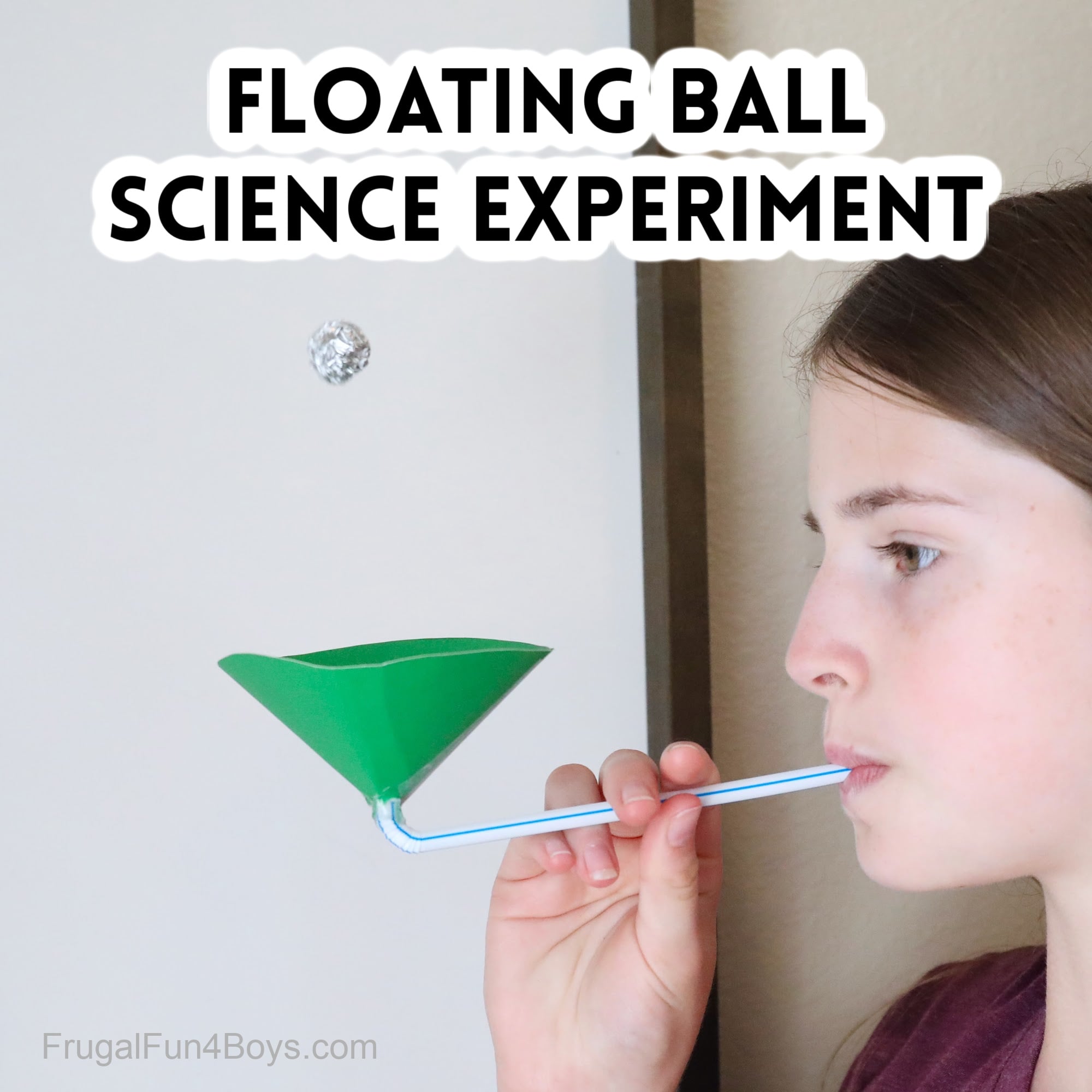
Make a ball levitate or float in the air!
This floating ball science experiment has been around for a long time, and I can’t believe we are just now trying it.
We had a lot of fun with this awesome physics science experiment. It’s impressive and feels more like a cool trick than like school work. After trying it and experimenting with the procedure for awhile, I definitely have some helpful tips to share.
You can also do this experiment with a ping pong ball! We tried both a ping pong ball and a foil ball, and I’ll explain below why I prefer the foil ball. However, there are benefits to both.
Supplies Needed for the Floating Ball Science Experiment:
- Card stock or heavy paper – we actually used a file folder
- A plastic bendy straw
- Scissors
- Clear tape
- Tin foil
- Hot glue gun
Step 1: Cut out a circle from your heavy paper or file folder. (Regular paper might work just fine, but we didn’t try it. Personally, I think it’s easier to make a cone shape out of paper that is heavier.)
We traced a bowl to get our circle shape.
Cut a slit from the edge of the circle to the center.

Step 2: Bend your circle into a cone. Use tape to secure it.
Step 3: Make a hole in the center of your cone. Insert a bendy straw. Cut the straw so that there is only a tiny bit sticking up into the cone.
You can use a little hot glue to secure your straw to the cone if needed.

Step 4: Make a small ball out of tin foil. It needs to be small! The goal is for it to be very lightweight, but as close to round as possible.

Now it’s time to try out your floating ball!
Place the foil ball inside the cone. Then blow slowly and steadily until you see the ball rise. This takes a little practice! A big burst of air will launch the ball out of the cone altogether, but if you don’t blow hard enough, it will just sit there.
The science behind the floating ball science experiment:
One thing to know right at the beginning is that the success of this experiment depends on the forces involved betweem the weight of the ball and the strength of the air being blown. We first tried this experiment with a ping pong ball and found that it was difficult for us to get it to levitate. I wanted to find something that would float easily with the amount of air that a elementary or middle school student could produce.
So we tried a small foil ball, and found it MUCH easier to get the experiment to work.

This science experiment is a demonstration of Bernoulli’s Principle, which states that when a fluid (in this case, air) moves quickly, the air pressure decreases. Airplanes fly because of the forces involved in Bernoulli’s Principle. The air moving over the top of the wing is moving faster than the air under the wing (because of the airfoil shape) which creates lift.
You’ll notice that the ball also spins while it’s floating!
There are multiple forces at work, and the physics involved here is quite complicated. For middle school and high school students, I would start this lesson by showing them the video in this post on Bernoulli’s Principle from Beals Science. The article has a lot of helpful information too! It goes further in depth for older students.
Need more science experiments?
Here’s a huge collection of more than 45 Science Experiments for Kids!

0 Comments
Post a Comment