
So, I’m homeschooling my second first grader (Did that make sense? My second son has reached first grade) and we’re on our FOURTH math curriculum. Actually, our curriculum-hopping spanned second grade as well. Kind of embarrassing considering that I was an education major and all!
Along the way, I’ve come to a couple of conclusions:
- No curriculum is perfect.
- Early math is best learned through a balance of both practical life experiences and book work – some programs focus on drill and others focus on building number sense and thinking skills. I think that you need both.
The other day, it dawned on me that first grade math can be summed up with a fairly simple list of skills, and most of the skills can be learned through regular life. Here is what I came up with. Keep in mind that I am not a school administrator or a curriculum writer – just a mom who has used a whole bunch of math programs!
Basic Skills for First Grade Math
- Count to 100
- Write and recognize numbers to 100 (A list I read online said 999, but none of the math programs that we have used have gone up that far in first grade)
- Place value for the ones and tens columns
- Skip count by 2’s, 5’s, and 10’s
- Recognize shapes
- Recognize left and right
- Ordinal numbers – 1st, 2nd, 3rd, etc
- Learn the days of the week and months of the year
- Tell time to the half hour, then to the quarter hour and minute
- Count money
- Add without carrying and subtract without re-grouping
- Read basic charts and bar graphs
- Basic fractions – half, quarter, third
- Measuring with both standard and non-standard units
Saxon Math: We started with Saxon 1st grade in Kindergarten for both Aidan and Gresham (I think that Saxon runs slightly behind). Saxon uses an approach called an “incremental approach.” This basically means that in each lesson, your child will learn a little bit of new material and will review several different concepts – counting by fives, identifying shapes, and a few addition problems, for example. The parent notebook tells you exactly what to say and do during the lesson. The lesson part in the parent notebook includes hands-on activities, and then there are worksheets to complete.
Pros: Easy to use, covers everything that your children need to know, prepares children for standardized tests. I really like the Saxon “Meeting Book.” We are currently using this for Gresham. Every day, he gets out his math meeting book and fills in the date on the calendar and records the weather on a bar graph. So good for first graders!
Cons: Learning is disjointed because the concepts are presented in such little pieces. I feel like the kids never get to really delve into a concept and master it. It’s also fairly boring, especially if your child does not need a lot of review. Here is a good review with some more thoughts on Saxon and concerns with the program. The more I have thought about it, I think that my main problem with Saxon is that it has not been a good use of my children’s time. They do not need to “color the circles red and color the triangles yellow.” That doesn’t teach anything about shapes! That teaches how to fill in worksheets and take standardized tests. I don’t want them to be unable to fill in worksheets or take standardized tests, but I don’t feel like we need to work on those skills every day.
Math-U-See: I didn’t finish 1st grade Saxon (his kindergarten year) with Aidan because we were both so bored to death. During the summer, I tried to figure out what to do for first grade! I decided to try Math-U-See. We borrowed the first grade Math-U-See and went through it quickly before staring second grade Math-U-See partway through his first grade year. Aidan enjoyed watching the DVD lessons for Math-U-See, and the hands-on approach was helpful for teaching borrowing and re-grouping. We still have the Math-U-See block set, and they are hands down the best manipulatives for teaching adding and subtracting!
Pros: Good for the visual and kinesthetic learner. It’s very different from other approaches, so if your child is struggling with one curriculum, it might be worth it to try Math-U-See, especially if you can borrow the parent book and DVD and just buy the student workbook. I like the manipulatives, because unlike cuisenaire rods, each unit is marked on the longer rods. One activity that I loved from M-U-S was building a 10’s fort. The child uses the blocks to build a tower with all of the ways to make 10 (a 2 block plus an 8 block, etc.) Very visual. The Math-U-See website has a great online drill program that you can use for free without buying their curriculum! We use it all the time.
Cons: Not comprehensive enough – does not give enough attention to time, money, and measurement. In the higher levels, the numbers get really huge. For example, instead of moving on to new material, the second grade book has students adding and subtracting 4 digit numbers (and I think it even went up to 5 digits). This gets tedious for young children. Only one new concept is introduced per week, which was not enough for Aidan. Every workbook page is the same (not the same problems, but the same skills) for a week.
Horizons: While I was going through 2nd grade Math-U-See with Aidan and realized that it was not comprehensive enough, I started supplementing with Horizons 2nd grade because some friends had given us that curriculum. Horizons might just be my least favorite math curriculum!
Pros: Like Saxon, Horizon will get the job done. Your children will learn math. They will be prepared for standardized tests.
Cons: The parent book was my biggest complaint. There are way too many learning objectives for each day. One or two of them would be new, and then there would be up to 5 review objectives. I felt like I couldn’t glace at the book and see what we were supposed to be learning that day, and for a busy mom, that just doesn’t work! The homework was also pretty long.
Making Math Meaningful: (from Cornerstone Curriculum) A friend introduced me to Making Math Meaningful from Cornerstone Curriculum, and I decided to give it a try. I ordered the second grade book for Aidan to use in his 2nd grade year even though we had already completed second grade Math-U-See.
**Quick Side Note: Although we started with 1st grade math in kindergarten, we did not stay a grade level ahead. I have received advice from veteran homeschool moms to not get too ahead in math, even for “smart” kids. Even really intelligent kids are not often developmentally ready to do abstract thinking (Algebra 1) earlier than 8th grade.
Making Math Meaningful is really different from other math curriculum. Since this post is about first grade math, I’ll focus on the first grade level.
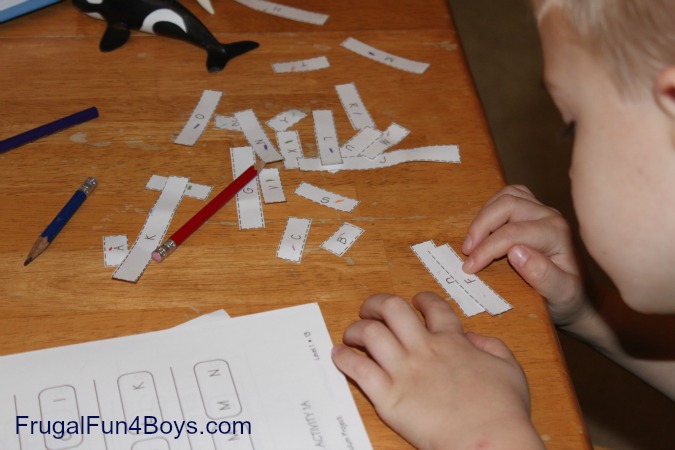
Gresham’s first lesson was about equal and not equal. He cut paper strips out of his workbook and compared the lengths to see if they were equal or not equal. He learned how the write the signs and write expressions like A (paper strip A) = D (paper strip D). (For comparison, Saxon first grade lesson one is on counting to 10.)
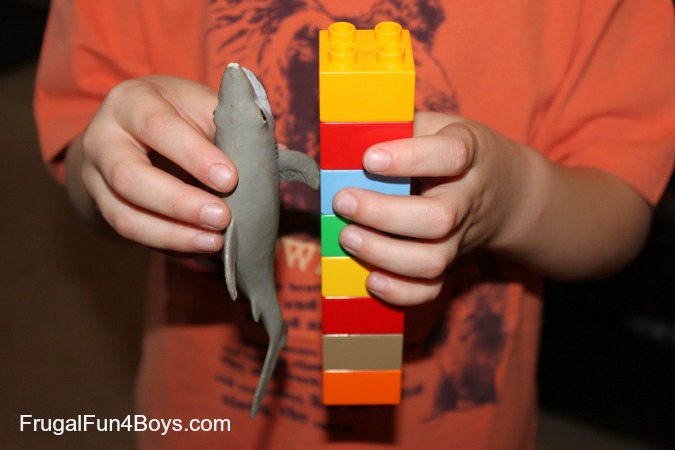
We did activities with pouring water to see if different containers were equal or not equal (compare a tall thin glass with a short fat one – it blows their minds at that age!). Gresham built a Duplo tower that was “equal” to his favorite toy shark:
I noticed that Gresham was starting to recognize equal and not equal in real life – “Look, this stick is equal to that stick!” After several days of practicing equal and not equal, Gresham learned about greater than and less than. For that concept, one of his activities was to play a card game. We made two sets of cards numbered 1-10. Each player would lay down a card at the same time, and would take turns placing a greater than, less than, or equal sign between the two number cards. Gresham loved it! Math is fun when it feels like a card game! He is currently learning about adding and subtracting at the same time – I’ve never seen an approach like this, and I really like it overall.
Pros: Making Math Meaningful is a bargain at $45 for both the student and parent books. I didn’t buy their manipulatives because we have such an assortment of stuff from our zillions of math programs! Making Math Meaningful teaches kids number sense, logic, and to really think. It has a lot of real life application and hands-on activities. In the upper elementary levels (Aidan is doing 4th grade right now), it is strong on teaching kids to choose the correct operation in a word problem.
Cons: MMM can be too abstract at times. Abstract thinking is a developmental thing – not an intelligence thing or an instructional thing. That being said, Aidan cried over one abstract concept in 2nd grade, but when we came back to the exact same concept in third grade, it was no problem. It is also too light on drill – I love the thinking skills, but kids need to have their math facts memorized. To remedy this, I’ve been supplementing with Rod and Staff math. Their math is very affordable at about $15 for the student textbooks (you don’t need the parent book), and it’s good math with a classic approach. I spent about $60 total to purchase two complete 4th grade programs for Aidan, and when MMM gets too abstract or he needs more drill practice, I pull out Rod and Staff. Gresham has been doing mainly MMM, but I’m getting ready to order first grade Rod and Staff for him.
Update April 15, 2013: After using MMM for all of first grade, I really like it! It’s tough at times, but develops really good thinking skills. I still recommend supplementing with additional drill.
Whew! Congratulations if you made it this far!
To sum up, my current plan is to use Making Math Meaningful with Rod and Staff as a supplement for both Aidan and Gresham (and Owen and Jonathan when they get old enough) through the elementary years. When we get to junior high, we’ll see where we go from there!
Final Thoughts:
- Don’t be afraid to scrap a curriculum that isn’t working.
- If you don’t like how your curriculum presents a concept, scrap that lesson and do it your way. You’re the parent, and you know how your child learns the best!
37 Comments
Leann @ Montessori Tidbits Oct 30, 2012
We are using RightStart this year, and are enjoying it so much more than MUS, which we used in K. We are enjoying the hands-on and game-based learning that it incorporates. We've tried Math Mammoth in the past, but it was a little too advanced in terms of verbage for my son's level, plus I'm not a huge fan of worksheets. Other than that MM is a nice curriculum that is quite thorough, and is great for enrichment.
Jamie Oct 30, 2012
Have you checked out the Common Core? I know the great state of Tx didn't adopt it but 47 other states did. It has a pretty solid listing of what kids should learn at each grade level in each subject. James thinks it is solid and he is using it with his first and second graders this year.
Phyllis at All Things Beautiful Oct 31, 2012
This is an excellent overview of the basic math programs people use! I enjoyed reading your insights.
Meggen Oct 31, 2012
This is our 2nd year of RightStart Math and really enjoy it. It touches on a good number of concepts (especially for the math thinking kid) and reviews a lot. For an active boy, the best part is that it uses lots of games and manipulatives to teach the concepts. I have never heard of Making Math Meaningful. I will need to check that out if we ever need to switch it up.
Amy Oct 31, 2012
This is our 3rd year (my son is 8) of using Horizons Math & we love it! My son really likes the student workbook. It is colorful and easy to use. I also really like all of the review. It helps my son remember what he is learning and it also shows me that he really understands the concepts. I agree with your comments about the teacher's guide. It is very overwhelming so I only use it for the answers. I look at the student book and create my own lesson plan. The teacher's guide seems to be designed for classroom teaching which is odd for homeschool curriculum. A little review each day is good but too much review can quickly become boring.
jc Oct 31, 2012
we haven't started math yet (we're K) because I cannot decide!!!! this post was helpful in making me realize I just need to bite the dust.
Shawndel Nov 1, 2012
We too have searched out math curriculums and after two years of crying through each lesson we finally switched to Saxon. I agree with your statement that not one is perfect but will need some supplementing. I too started a list on what is essential to know and will use that along with our curriculum. So far my children are Lovin Saxon it's fun and hands on. It does have a bit if everything which I think my 2nd grader likes but I do think the kindergarten is very simple. Thank you for your honesty and helpful review. It's great to know I am not alone in this area!
mmd Nov 2, 2012
We are doing Singapore math with my 2nd grader. does anyone have thoughts on how this compares to the curriculum above? i'm really not diggin' it. Looking for something else.
Sarah Nov 3, 2012
It's great to hear all of your thoughts! I have never heard of Right Start - I'll definitely need to check that one out. Not because I want to switch again, but I'm curious about it!
Donna Feb 3, 2013
Thanks so much for the overview. We are just now trying to work out what programme to do for our four year old son, and have been looking three of your menitoned so it was very helpful. We are new to home edding. I had wondered about the maths you see, whether their manipulatives were enough! and I guess you have answered that one. It also helped you clarifying about the abstract side of things not being a matter of intellect. So now i will check out M M M and Right Start.
THanks again!
Jerilyn Jun 18, 2013
I commented above as "jc" and finally decided on a program- we've started Saxon 1 for first grade last month. We are really enjoying it! My son loves math! I like how simple it is for me to teach- not a ton of prep time. He may not need to color in certain things but its helping him sit down and focus on something. He is very fidgety and hates writing but I think this will help him in this area. I'm so glad we've found something we like!
Teresa Jun 18, 2013
Hi, thanks for the insight into maths programs. Have you tried Life of Fred? I'm curious as to how good it is at starting from day one. Wondering if the child needs to be able to read before using it or if it would be ok for the adult to read aloud?
Bree Jun 30, 2013
I have a question when using MMM do you need both books parent and student copy?
Sarah Jul 1, 2013
I would recommend getting both books. The parent book has ideas for hands-on activities and more explanation than the student book. It also has all the answers to the work pages.
Jenny Jul 11, 2013
We started Right Start with my daughter when she was 4, but ended up switching to Singapore. I love Right Start in that it teaches children to really understand math concepts and number sense form a conceptual standpoint. However, there is quite a bit of parental prep work, and the many manipulatives were a bit distracting for my daughter at times. She would dutifully sit through the lesson, but really just be waiting to be done so she could play with the manipulatives. I also have a 3 year old son, who is quite active. Trying to do Right Start while keeping him in check was too hard. Singapore has worked out well for us.
Julie Jul 21, 2013
We use Math Mammoth. It's great! Our active 8 yr-old boy loves it. The lessons are not extremely long and they learn. In fact, I've learned a lot too. This is our second year using it and we now have one in 1st, 2nd, and 3rd grade.
Kimberly Locke Aug 30, 2013
I'm using Mathematical Reasoning Workbooks from The Critical Thinking Company and my son and daughter love them. We also use Cuisenaire Rods with Miquon Math. I'd like to see some Life of Fred books too. We also play UNO, Go Fish, Blokus, and many more. We revel in Base Ten blocks, shapes, and teddy bear counters. I bought the Melissa and Doug calendar for this year, and we think of math time as "Math Lab" and try to really think and play together. It's going well!
Michelle Nov 21, 2013
After 14 years and multiple, multiple math changes we found our place with Christian Light Math a few years ago. It is incremental as well, but not to the extent that Saxon is. It is also inexpensive and easy to accelerate if necessary. Awesome program.
Naomi Jan 27, 2014
I was looking at the rod and staff math and was wondering what book you used?
Amy C. Feb 3, 2014
We have been using math-u-see and really like it. I find the DVD to be a huge bonus & our lessons are done much faster when we use that for the explanations (rather than me just explaining it...even though I was a classroom teacher before...he is very succinct & his explanations are great & clear, imo).
I was glad to read your reviews of the other programs as well. I've sometimes wondered about switching. We visited a classical conversations group this past week & so many of the moms were using Saxon. I used it as a high school student and HATED it & have had a huge aversion to it since then. Was nice to read of someone else who also wasn't wild about it. Guess it all comes down to learning/teaching styles & what works for your family.
Heather Feb 26, 2014
I have been through about 18 different math programs with my 5 kids so far. Several kids have difficulty with math. TouchMath was great for understanding the basics. R&S became too slow for us. Christian Light Education is the right blend for my kids. Not too much new, not too much review, and not too much drill everyday. ANother plus: not too much money for 5 levels!
Jill Mar 18, 2014
We are using Horizons for 1st grade and I love it. My son does need the repetition and I like to see that he "gets it" when we go from lesson to lesson. I do plan on using Horizons for 2nd grade too but who knows we could change. I try to keep an open mind with all curriculum.
Kristina @ School Time Snippets Mar 30, 2014
Saw this come through on my Pinterest feed! I agonized over what to switch to last year after MUS. I agree with much of what you noted about the curriculum and it just (surprisingly) wasn't a good fit for my son. He didn't get into the blocks, which I think is the heart of the program when you first start using it. Happy to say we switched to Christian Light and we are very happy with it. I also purchased Life of Fred and we read through that every now and then. Hope Making Math Meaningful is still working for you!
Sarah Mar 30, 2014
I have never seen Christian Light or Life of Fred, and I really need to check those out - mainly because I'm curious! We are still liking Making Math Meaningful. In fact, I can see the value of it more and more the longer we stick with it. My oldest is just finishing 5th grade, and I feel like supplementing MMM with Rod and Staff has been especially helpful at this age because it covers much more with fractions and decimals. But overall, I love MMM!
Angela Mar 31, 2014
Thank you for your reviews! I just started homeschooling my kindergartener 2 months ago and have been scouring the web to figure out something for him and his sister who will be in kindergarten next year. My husband really wants us to use Singapore for lots of reasons, so we're going to make a go of that, but I think I'll get the MUS manipulatives to go with it and supplement with something like Rod & Staff because I read that it's short on drill. I'm sure it probably won't work for both of them, as I read more and more stories that most homeschool families try numerous programs.
Lindsay Christian Apr 22, 2014
I hated Horizon's math too and I've heard so many complaints about Saxon Math as well! I think we have tried 3 different math programs as well. Thanks for the reviews! I was thinking about Math-U-See for our next attempt.
Kim Wren Apr 27, 2014
I am just getting started with homeschooling and am completely overwhelmed with the amount of curriculum out there. I am a teacher so it is a change in thinking for me. I found this post to be VERY helpful and will look into these for my son.
answers.kohls.com May 17, 2014
The other day, while I was at work, my cousin stole my apple ipad and tested to see if it
can survive a thirty foot drop, just so she can be a youtube sensation.
My apple ipad is now broken and she has 83 views. I know this is totally off topic but I had
to share it with someone!
buy windows vps May 18, 2014
hey there and thank you for your information – I've certainly picked up anything
new from right here. I did however expertise some technical points using this site, since I experienced to reload
the site a lot of times previous to I could get it to
load correctly. I had been wondering if your web host is OK?
Not that I'm complaining, but slow loading instances times will often affect your placement in google and
can damage your quality score if ads and marketing with Adwords.
Anyway I'm adding this RSS to my email and can look out
for much more of your respective fascinating content.
Make sure you update this again very soon.
Lindsey W Jun 30, 2014
I know Saxon is not for everyone. But I have really enjoyed it. I started it in Kinder with my then 5.5 year old and with my 4.5 year old with the 1st grade book. Since then I have used the 1st grade book on my other 4.5 year old son. So yes Saxon does run 1 year behind. We just finished the 3rd grade book with my 2nd grade kids. So after 3 years of Saxon I can say I love the program. I love how the topics build gently and incrementally. The beginning of each Saxon book starts very very slowly. So if you have not used I before you will find it very basic. But they want to make sure your child has a firm foundation on basics before moving on. Saxon gives a fantastic foundation in math. I love that it is hands on and fun, and that the topics get visited every 5 days through out the whole book. You never finish a chapter and move on. Which is my problem with most math programs. The topics are constantly reinforced. It really produces kids with great problem solving skills. My degree is also in elementary ed. So math is one of the curriculums I researched and researched and found this one to fit my personality best.
Ashley Oct 13, 2014
I agree with your opinion. While I'd LOVE for Saxon to be a little bit more colorful, I really like the content. And we, too, are a grade level ahead -- so my 1st grader is doing 2nd grade Saxon Math and EXCELLENT. It does get a bit time consuming, but we just skip things we know and sometimes don't do both sides of the worksheets if we've mastered it. Overall, I love it and will continue on with this kiddo! :)
Lavada Sep 5, 2014
Thanks for another magnificent article. The place else may anybody
get that type of information in such a perfect way
of writing? I have a presentation next week, and
I'm on the look for such information.
M.L. Feb 17, 2015
I have two sons, ages 8 and 12. This is our first year homeschooling. I agonized over math curriculum and finally settled on Math U See. My oldest has learning disabilities (along with other disabilities) and was behind in math and language arts. Math U See has been GREAT for him. He has been doing the Gamma series this year and i felt like it really reinforces Multiplication for him. He struggled greatly in public school with multiplication. I found it interesting that the entire year is spent working on this one skill--but found that it is very thorough--which works very well for him because he needs to move at a slower pace and really immerse himself in what he is learning . The method is very different than what he was learning in school, and it works for him better thank I could have hoped for. I agree that things like telling time, measurements, and counting money are kind of pushed to the side--however, this is not something I am worried about at this time. I feel like those are lessons that he can learn independently. (although in Gamma, they do talk about units of measure in almost every lesson--such as pints/quarts/gallons, teaspoons/tablespoons, etc. He uses counting by numbers to reinforce these measurements) My youngest is doing the Beta series, and he is getting bored with it. I have found that he will make sloppy mistakes because he's trying to get through the worksheets. I have stuck with MUS with him though because in public school he learned some poor math skills that we've had to get past and correct. For this purpose, MUS has been very very effective.
Rachel Mar 17, 2015
Great article! We are starting 1st grade in the fall, and I want to try MMM. Did you buy the Rod & Staff workbooks (part 1&2), practice sheets, or math speed drills as supplementals? Also, do you have any experience with Ray's arithmatic? We used that with some games for kinder this year and he liked it. Just wondering if anyone had experience using that through elementary?
Tiffany Jul 15, 2015
We love Singapore. The textbook and workbook are engaging and our first grader is doing very well with this program.
Amanda Aug 5, 2015
We just started Math U See and have had tears or boredom every time. I have felt awful and feel like Making Math Meaningful might just be the right fit for my son. I really appreciate the time you took to make pros and cons for each. Thanks for the insight and hopefully we will get this figured out soon!
Christen Nov 15, 2015
I have a much older child but am reading this because I may also homeschool a younger child in the future. I started with Singapore Math for 6th grade, and frankly, we didn't get past the first few lessons. It was too hard for him and not user friendly at all. We then switched to Christian Light Education, which we still use. I really like it but it is probably most similar to the way you described the Saxon Math: a small lesson and lots of review. The focus on review has been really good for my son, but not all kids may need the amount of review it has. Again, however, I am only referring to older grades and haven't used their younger grade materials. It is very affordable which is another plus.
Marie Mack Jul 26, 2016
I have been reading about 1st grade math curriculum for weeks! My head is going to explode. I'm just not sure what our son is going to like. I really appreciate the confidence you give to know I can scrap a program and try something new! We are going to start with Saxon math from the recommendation of my Aunt who has been a math tutor for almost 15 years and homeschooled 4 children. My hope is to have a base curriculum of work off of and find supplements for how our oldest and his personality. Very helpful reviews of all the curriculum
Preston Dec 2, 2017
I'm now not positive where you're getting yokur info, however good topic.
I must spend some time stuydying much more or understanding more.
Thank you ffor geat information I was in search of this info
for my mission.
Sarah Oct 17, 2018
What are you using now for 1st grade?? Mine kindergartener is doing The Good and the Beautiful math and we’re really enjoying it but it is very easy for him...I’m thinking about supplementing with something.
Post a Comment